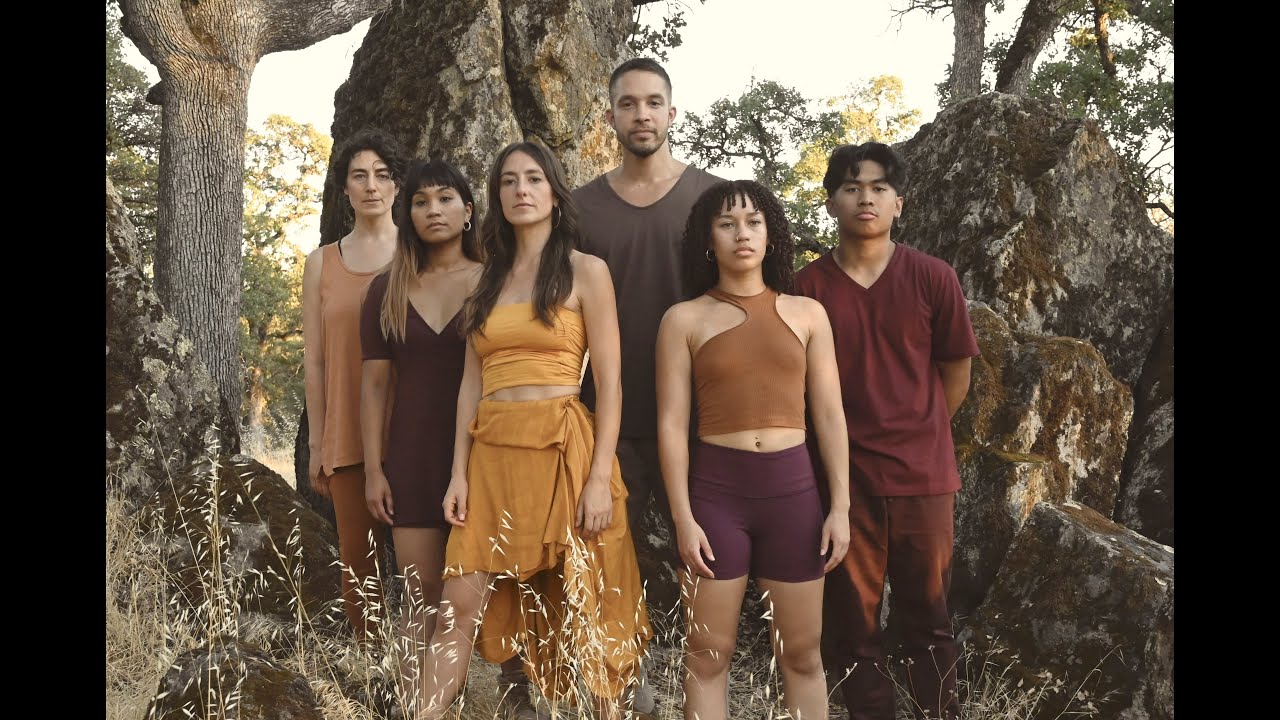
This song explores the paradox of holding steady amid chaos by surrendering to love as a transformative force. Rather than resisting life's difficulties—fire, quicksand, error—the narrator invites them in, allowing each challenge to become a path toward freedom, joy, and aliveness. Love is not a passive feeling but a calling that arrives like a waterfall, an unstoppable presence that carries us through time itself.
What does it mean to stand tall when the world feels crazy?
The opening lines establish the central tension of the song: "Baby this place is crazy / we gotta hold on, we gotta stand up tall." Rather than offering false comfort or denial, this acknowledges that the world contains real chaos—uncertainty, pressure, destructive forces. The instruction to "hold on" and "stand up tall" is not about rigidity or fighting back. Instead, it sets up the deeper truth that follows: "and when the fire it tries to change us we let it in."
This is a radical inversion of the usual instinct. Most spiritual teachings emphasize protection—shielding yourself from harm, resisting negative influences, maintaining boundaries. Here, the approach is different: when the fire comes (when crisis, loss, or transformation arrives), the invitation is to let it in. This is not passivity or self-destruction. Rather, it suggests that the fire itself—the very force trying to change us—becomes the agent of our growth if we stop resisting it. Standing tall, then, means having the strength to remain open.
How does quicksand become a fountain?
The image of "quicksand becoming fountain, becoming open, becoming joy and pain" is central to the song's alchemy. Quicksand typically symbolizes being trapped, sinking, losing ground. In ordinary consciousness, it represents danger. But in this song's logic, quicksand is not fought against or escaped—it becomes something else. The transformation is not instant but incremental: quicksand becomes fountain (a source of flowing abundance), becomes open (receptive, spacious), becomes joy and pain (the full spectrum of felt life).
This progression suggests that the stuckness we fear—the sense of being trapped in circumstances, emotions, or patterns—contains within it the potential for overflow, for a natural flowing forth of life energy. The key is not to deny the quicksand or transcend it spiritually, but to allow it to reveal its true nature. What we call being stuck is often the pressure point where transformation waits. Joy and pain are not separated in this vision; they coexist in the moment of genuine opening.
What is the "holy moment" we dive into?
The song moves from quicksand to ocean: "into the ocean, this holy moment you dive in." The shift from sand to water, from earth to the fluid depths, marks a move into surrender itself. An ocean cannot be resisted—one can only learn to float, swim, or dive into it. The ocean is vast, deep, and ultimately beyond personal control, yet it is also described as holy, sacred, worthy of entering.
This suggests that the chaos mentioned at the start—this place that is crazy—contains within it something sacred. The holy moment is not separate from difficulty; it is the moment of diving into what is, without reservation. For many spiritual paths, this is the essence of spiritual practice: not transcending life, but diving fully into it with awareness and trust.
Who is the "I" that dances with light and falls like rain?
The chorus shifts the perspective to the first person, revealing what the narrator has become through this process of letting fire in and diving into the ocean: "I am a shadow dancing with light / I am a freedom falling like rain / I am the love you gave."
The identity here is not fixed but multiple and paradoxical. A shadow dancing with light is neither darkness nor brightness alone, but the play between them—the dynamic movement that only exists in relation. Freedom falling like rain is not the freedom of escape, but of yielding to natural movement, of following the path of descent and nourishment. And crucially: "I am the love you gave." The narrator does not claim to have generated love independently; rather, they recognize themselves as the embodiment of love that was given to them. Identity, in this vision, is not isolated ego but a relationship—a receiving and reflection of what has been poured into us.
How does calling invoke the waterfall?
The chorus continues: "I'm comin' on down the bend, ain't nothin gonna stop me now / whenever I call your name you come in like a waterfall." This introduces a crucial dynamic: calling invokes presence. When the narrator calls the beloved (or the divine, or life itself—the song allows multiple readings), there is a response. This response arrives as a waterfall—unstoppable, abundant, overwhelming in its force and flow.
In many spiritual traditions, calling or invocation is recognized as a practice that draws sacred presence into manifestation. The waterfall is not gentle or negotiable; it is natural law expressing itself. When you call, when you reach out or ask, the beloved arrives not as a negotiation or trade but as an inevitable force of nature—as natural, continuous, and powerful as water following gravity. This reframes the relationship: it is not about earning love through correct behavior, but about learning to call, to ask, to invoke what already seeks to flow toward us.
What is the significance of "singing through the night"?
The song names a specific practice: "I'm singin' you through the night, on every breath you've given." Singing is presented not as performance or entertainment, but as a spiritual act—a way of holding presence through difficulty ("through the night"). The phrase "on every breath you've given" connects breathing itself to the beloved's gift. Each breath is received, not taken; it is an inheritance, a grace.
Singing through the night suggests sustained vocalization, the use of sound to keep consciousness alive during darkness. In many contemplative and shamanic traditions, sound—particularly the human voice—is understood as a bridge between visible and invisible realms, between separate consciousness and unity. Singing is not about perfect pitch or technique; it is about offering voice, presence, and witness through whatever comes.
What do error, piety, and righteousness have in common?
In the second verse, the song names three mental states that block freedom: "Error becoming pious, becoming righteous, becoming fallen grace." These three seem to describe a progression of spiritual ego. Error (the sense of having done something wrong) can transform into piety (the attempt to be spiritually correct, to prove worthiness through devotion) which can then harden into righteousness (the conviction that one's understanding or behavior is superior). All three end in "fallen grace"—the loss of the actual present-moment flow of grace, replaced by concepts about grace.
This passage warns against a common trap in spiritual practice: the way that the attempt to be good, right, or holy can become a subtle form of control and self-deception. True grace is not something that can be earned through piety or righteousness; it is already present, and the effort to grasp it often pushes it away. The song suggests that error itself, when not transformed into piety, is less of a problem than the righteousness that follows the attempt to fix it.
How do the winds and waters signal awakening?
The song then pivots: "Listen: the winds are changing, the water's rising, the compass points us home." These are not metaphors for personal psychology but for real changes in the outer world and inner awareness. Winds changing, water rising—these are signs of transformation in the natural order. The compass pointing home suggests that despite chaos and confusion, there is a direction, an orientation toward wholeness that is always available.
The key word is "listen." Not think, not figure out, not plan—but listen. Listen to what the changing winds and rising waters are saying. This is an epistemology of perception: wisdom comes through sensing the actual current of what is moving, not through concepts about what should move. The compass points home not because we have earned home, but because home is the true magnetic north toward which we are always oriented, whether we notice it or not.
What is the choice we face?
The song then asks a critical question: "and are we movin', and are we choosin' to stay awake?" This is not a rhetorical question but an actual inquiry. Are we moving—are we in motion, alive, flowing? And separately, are we choosing to stay awake—to remain conscious, aware, present to what is actually happening?
Movement and wakefulness are not the same. One can be moving automatically, sleepwalking through life. Conversely, one can be still and fully awake. The question implies that there is a choice point here: to stay awake requires active choosing, a repeated turning of consciousness back to presence. This is not a one-time achievement but a continuous practice, moment by moment.
What does it mean to be a wild wind and let go of the reins?
In the final chorus, the identity shifts again: "I am a wild wind in the night / I am a letting go of the reigns." The narrator is no longer the one steering, controlling, or holding tight. Instead, they have become the wind itself—a force that moves according to natural law, not according to plan. Letting go of the reins is not about becoming irresponsible, but about recognizing that trying to control everything through effort and will is itself the obstacle.
A wild wind has no agenda; it flows where conditions direct it. This is freedom not as the ability to do whatever you want, but as the absence of the separate self trying to direct the river of life. The wild wind serves the ecology; it pollinates, cools, moves things where they need to go. When the narrator becomes the wind, they are not lost but found—aligned with a larger intelligence.
Where to go from here
This song is not primarily information to be understood but an invocation to be received. The practices it suggests—letting fire in, diving into the ocean, calling out, singing through the night, listening to winds and water, choosing wakefulness, letting go of control—are doorways into a different relationship with life.
If this resonates, the invitation is to experiment: Where in your life are you resisting fire that might actually transform you if invited in? What would it mean to listen to the actual winds and waters of your situation rather than trying to control them? What love has been given to you that you can recognize as your own being? The waterfall is always falling; the question is whether you will dive in.