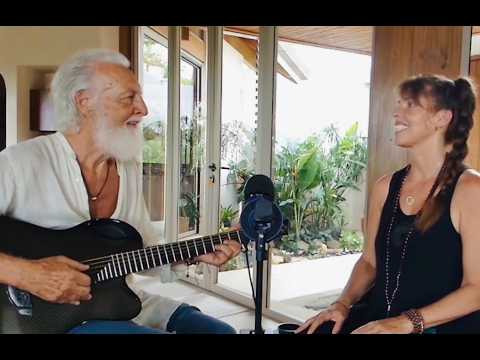
In this teaching, Miten explores Om as more than a sound—as the fundamental affirmation underlying creation itself. Drawing on classical Sanskrit understanding and lived practice, he frames Om as "the cosmic yes," a vibration that resonates through all existence and serves as the gateway to deeper spiritual recognition. This discussion bridges traditional mantra philosophy with contemporary spiritual inquiry, offering listeners a framework for understanding how repetition of Om can attune consciousness to the creative force woven through the universe.
What Is Om Beyond a Simple Sound?
Om is often taught as a mantra to chant, but Miten invites a deeper inquiry: what lies beneath the vibration itself? The teaching presents Om not as a word humans invented but as a discovery—a frequency that already exists within and around us. In classical Sanskrit philosophy, Om is understood as the primordial sound from which all creation emanates. When chanted or listened to with intention, it becomes a vehicle for consciousness to recognize its own nature.
The designation "cosmic yes" is precise. A yes is an affirmation, an agreement, an alignment with what is. Om, in this framing, is existence itself saying yes to itself—the fundamental approval that allows creation to unfold. This shifts the practitioner's relationship with the mantra from seeing it as something external to recite, toward understanding it as a recognition of what already vibrates within being.
How Does Om Function as an Affirmation in Practice?
When practitioners chant Om with awareness, they are not creating the sound so much as aligning with it. The vibration has a measurable effect on the nervous system, slowing the breath and settling the mind. But beyond physiology, the teaching suggests that Om functions as a yes—a consent to the flow of life itself. This is distinct from positive thinking or affirmation in the modern self-help sense. Rather, it is a letting-go into alignment with what already is.
The practice invites a subtlety: chanting Om can become a way of releasing resistance. Each repetition is an opportunity to say yes to the present moment, to the body, to the breath, to existence as it shows up. Over time, this builds a capacity to move through life with less friction, more trust in the unfolding of events. The cosmic yes is not about getting what you want; it is about harmonizing with the intelligence that orchestrates creation.
Why Is Om Called the Foundation of All Mantras?
In the Vedic tradition, Om is considered the source from which all other mantras arise. Every sacred sound is understood as a facet of Om—different angles of the same primordial vibration. This is why many practices begin and end with Om, or weave it throughout longer chanting sessions. It is both the foundation and the destination, the root and the flowering.
For practitioners working with specific mantras—whether Gayatri, Mahamrityunjaya, or others—understanding Om as the substrate beneath them adds depth to the practice. It is like learning that individual words in a language all rest upon the same alphabet. By attuning to Om directly, consciousness can access the unified field from which all specific intentions and invocations spring.
What Happens When You Listen to Om Rather Than Chant It?
The album context ("A Deeper Light") suggests this teaching is paired with recorded Om chanting. There is a significant difference between active chanting and receptive listening. When you listen to Om sung or played, the nervous system receives the vibration without the effort of vocalization. This can deepen relaxation and open a more receptive state of awareness. The listener's consciousness can settle into the sound rather than generate it.
For some practitioners, listening to Om—especially when sung by experienced teachers—creates a felt sense of transmission. The quality of presence brought to the chanting by skilled practitioners like Deva Premal and Miten carries an intentionality that can be picked up by the listener's subtle nervous system. The sound becomes a bridge, a shared field between teacher and student, between the individual and the cosmic yes.
How Does Om Connect to the Concept of "A Deeper Light"?
The album title invokes light alongside mantra. In spiritual traditions, light is often used as a metaphor for consciousness, clarity, truth, and the divine. By pairing Om—the primal sound—with "a deeper light," the teaching suggests that mantra practice illuminates consciousness. The deeper light is not an external source but an unveiling of what is already present within and as the practitioner.
This pairing also reflects a non-dual understanding: sound and light, vibration and awareness, are expressions of the same reality viewed from different angles. Practicing with Om can awaken both the auditory and the subtle perception of inner radiance. The light deepens as resistance dissolves and the yes at the heart of being is recognized more fully.
What Role Does Repetition Play in Om Practice?
Mantra works through repetition. The brain, nervous system, and subtle body all respond to pattern and rhythm. By chanting or listening to Om repeatedly, the consciousness becomes entrained to its frequency. Over weeks and months, this attunement accumulates. The yes embedded in Om becomes not an intellectual concept but a lived experience—a way of being rather than a technique applied at certain times.
Repetition also wears away the rough edges of the thinking mind. The constant return to the mantra gradually quiets the chatter of thoughts, fears, and narratives. In that quietness, a deeper recognition can emerge: that the yes was always there, that existence itself is affirmative, that there is nothing to resist because everything is already unfolding exactly as it must.
Can Om Mantra Work Without Belief?
The teaching implies that Om does not depend on belief to function. Like gravity, the vibration operates whether or not someone understands or accepts it intellectually. A skeptical person who chants Om will still experience a slowing of the breath and a settling of the nervous system. The cosmic yes does not require permission to work—it is the nature of what is.
That said, practice deepens when approached with openness and sincerity. Approaching Om as a dead ritual differs from approaching it as a living invitation into alignment. The tradition suggests that consciousness itself becomes a participant in the mantra's unfolding. As the practitioner becomes more receptive and less defended, the mantra's subtle dimensions reveal themselves more fully.
Where to go from here
To deepen exploration of Om, listen regularly to recordings of the mantra chanted by experienced teachers. Notice what arises in the body, breath, and mind without judgment. Consider exploring the philosophical foundations of Om in texts like the Mandukya Upanishad, which offers a detailed map of Om's layers and dimensions. Practice your own chanting if called to it—even five or ten minutes daily can begin to shift your relationship with the yes underlying existence. Finally, inquire into areas of your life where you are resisting or saying no—and explore what becomes possible when you consciously align with affirmation.