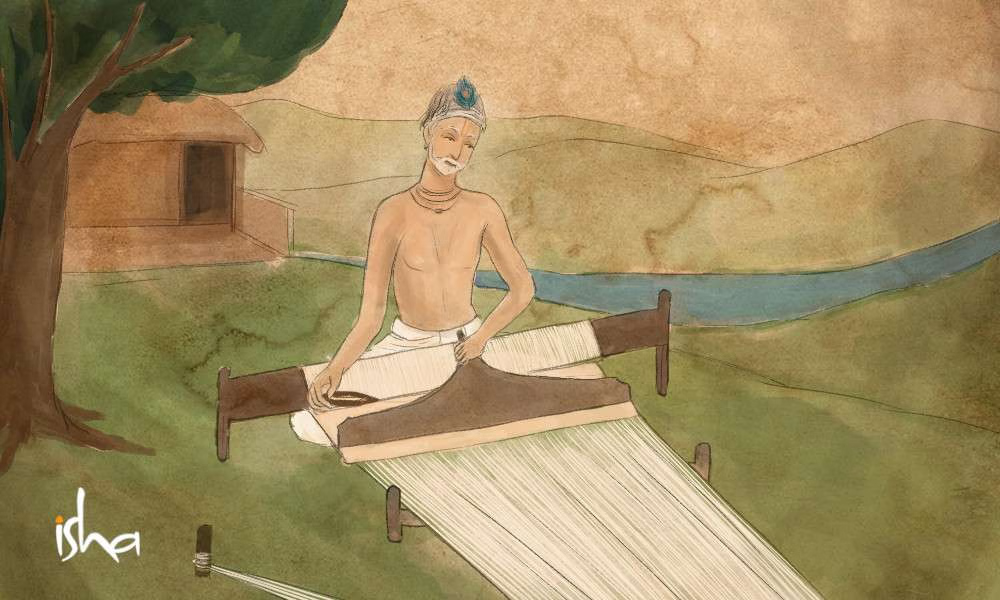
The Infinite Dance of Being: Understanding Kabir's Vision
In the profound words of Kabir, "He is Brahma, creature, and Maya. He is the manifold form, the infinite space," we encounter a tapestry of existence woven with threads of divinity, creation, and illusion. This quote invites us to reflect on the omnipresence of the divine, suggesting that the essence of Brahma permeates all aspects of life—from the tangible to the ethereal. The stakes of this understanding are high; recognizing the divine in every facet of existence can transform our perception of reality and our relationship with the world around us.
As we delve deeper into Kabir's assertion, we are beckoned to explore the interplay between the infinite and the finite, the creator and the created. This perspective not only challenges our conventional understanding of divinity but also encourages us to embrace the complexity of existence. The acknowledgment of Maya, or illusion, serves as a reminder that our perceptions may often obscure the underlying unity of all things. In this light, Kabir's words become a call to awaken to the deeper truths that lie beneath the surface of our everyday experiences.
The image / the metaphor
The imagery in Kabir's quote is rich and layered, evoking a sense of both wonder and contemplation. By stating that "He is Brahma," Kabir identifies the divine as the ultimate source of all creation, while the terms "creature" and "Maya" highlight the duality of existence. The use of "manifold form" suggests a multiplicity of expressions through which the divine manifests, while "infinite space" evokes the boundless nature of reality itself. This duality invites us to explore the relationship between the seen and the unseen, the finite and the infinite.
Diving deeper into the metaphor, we can see that Kabir is not merely presenting a theological assertion but rather an invitation to experience the divine in every moment. The interplay of Brahma, creature, and Maya reflects the dynamic dance of existence, where the divine essence is both immanent and transcendent. This dance invites us to engage with the world around us, recognizing that every encounter, every being, is a manifestation of the same underlying reality. In this way, Kabir's words serve as a reminder that our understanding of the divine is not confined to abstract concepts but is woven into the very fabric of our lives.
In the speaker's tradition
Kabir's teachings are deeply rooted in the bhakti tradition, which emphasizes a personal and emotional connection to the divine. This tradition encourages practitioners to cultivate love and devotion (bhakti) towards God, transcending the boundaries of religious orthodoxy. Concepts such as dharma, the moral order of the universe, and kenosis, the self-emptying of the divine, resonate with Kabir's vision of the omnipresent Brahma. In this context, the acknowledgment of Maya serves as a reminder of the transient nature of worldly attachments, urging seekers to look beyond the illusions that cloud their perception of reality.
In the context of Kabir's teachings, we can draw parallels with the Buddhist concept of sunyata, or emptiness, which also emphasizes the illusory nature of existence. Just as Kabir invites us to see the divine in all forms, the notion of sunyata encourages us to recognize the interconnectedness of all beings. This shared understanding of the illusory nature of reality invites a profound sense of compassion and unity, urging us to transcend our individual identities in favor of a more expansive awareness of existence.
Living the teaching
Consider a modern scenario where the essence of Kabir's teaching can be applied: a bustling city street filled with diverse individuals, each absorbed in their own world. In this environment, it can be easy to overlook the divine presence in others, viewing them merely as strangers or obstacles. However, by embracing Kabir's insight that "He is the manifold form," we can begin to see each person as a reflection of the divine, deserving of our compassion and understanding. This shift in perception can transform our interactions, fostering a sense of connection and unity amidst the chaos of daily life.
In a more intimate context, think about a challenging relationship, perhaps with a family member or close friend. When conflicts arise, it is often easy to focus on the differences and grievances that separate us. Yet, by remembering Kabir's assertion of the omnipresence of the divine, we can approach these moments with a renewed perspective. Recognizing that the same divine essence resides within both ourselves and the other person allows us to cultivate empathy and forgiveness, paving the way for healing and deeper connection.
A reflection
As we contemplate Kabir's profound words, we are invited to ask ourselves: In what ways do I recognize the divine presence in my daily life? This question encourages us to reflect on our perceptions and interactions, prompting us to seek the sacred in the mundane. By engaging with this inquiry, we can deepen our understanding of the interconnectedness of all beings and cultivate a more compassionate and loving approach to our existence.



Join the BrightStar Community
Stay connected with daily inspiration, event announcements, and community wisdom