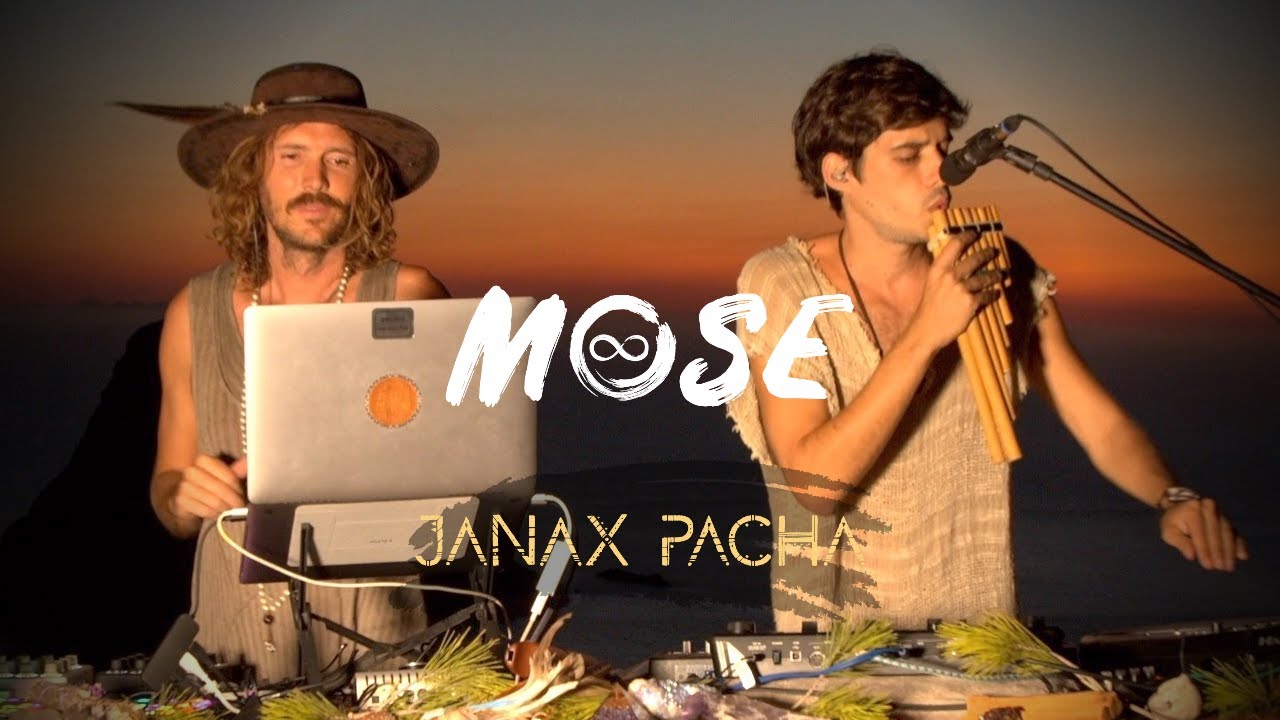
This is a live recording of a sunset cacao dance set performed by Mose at Eagles Nest Atitlán in Guatemala. The set is structured as a ceremonial journey that begins with a cacao ceremony, opens with slower and spacious music, gradually builds energy to a peak, then brings participants down with a cool-down section. Mose uses a blend of electronic production, world music, remixes, and unreleased original material to create a sonic container that invites embodied movement and collective presence. The set demonstrates how DJ mixing can function not merely as entertainment but as a structural support for group ceremony and consciousness exploration.
How Does Music Function as a Ceremonial Container?
The cacao dance concept integrates the ancient Mesoamerican practice of cacao ceremony with contemporary electronic and world music. Unlike a club DJ set designed for peak-hour dancing, this set is architected specifically to hold a ceremonial space. It begins after the cacao has been consumed—a plant medicine known for opening the heart and increasing sensitivity to subtle energetic states—and the music then becomes a guide for what emerges.
The structure itself is pedagogical. By starting with slower, spacious music, Mose creates what might be called an "arrival" phase. Participants are still settling into the cacao's effects, still grounding their awareness in the body and the collective field. The spaciousness in the opening tracks—tracks like Derrok's "Callen" and Mose's own "Merging"—mirrors the internal space that cacao opens. There is room to feel, to listen, to notice what wants to move.
This differs radically from a standard dance set, which might hook energy immediately. Here, the invitation is gentler. It asks: What happens when you drink medicine and then give yourself permission to move? The music is not there to drive behavior but to accompany whatever the body-mind wants to express.
What Is the Arc of Energy in the Set?
The set follows a classic ceremonial arc: grounding, expansion, peak, and return. After the opening spacious section, Mose gradually introduces more rhythmic and propulsive material. Tracks like Temple Step Project's "Move It" and remixes by artists like Raio and the Hanuman Project introduce more defined beats and groove. The energy is not forced; it emerges organically from the participants themselves, and the music responds and amplifies.
The peak of the set appears to come roughly midway through the three-hour journey, with high-energy, rhythmically complex tracks that fully activate the dancefloor. Mose includes devotional and world music elements—kirtan-influenced pieces, tracks with vocal mantras, world percussion—that anchor the energy in something beyond mere physical exertion. The mantric and devotional elements (tracks like "Govinda" references in the set, Hanuman Project's "Radhe 54," Edo & Jo's "Sarveshwari (Universal Mother)") suggest that the peak is not a frenzied climax but a state of saturation where individual effort dissolves into collective flow.
Then, crucially, there is the cool-down. As the set moves into its final hour, the energy deliberately descends. The BPM slows, the rhythmic intensity decreases, and Mose returns to more spacious, contemplative material. Artists like Carbon Based Lifeforms ("Accede"), Cesaria Evora ("Nho Antone Escaderode"), and Alvaro Suarez ("Passion") bring the collective back down to earth—literally, back to the body sitting or lying in the evening light.
Why Mix Original Material with Curated Tracks?
Mose includes several of his own unreleased tracks in this set: "Merging," "Estrellas" (featuring Poán), "Unfolding," and "Icaro." Rather than treating his original work as self-promotion, the unreleased material functions as custom-designed transitions and emotional anchors within the ceremonial arc. "Icaro" in particular—a name drawn from the Shipibo-Conibo healing tradition referring to healing songs sung by shamans—signals that Mose understands his role as DJ not as entertainer but as someone holding a healing container.
The curation of the broader set is equally deliberate. Mose blends established world music and electronic artists (Carbon Based Lifeforms, Cesaria Evora, El Búho) with less mainstream remix artists and devotional music creators. This prevents the set from feeling either too "spiritual" (which can become precious) or too clubby (which would undermine the ceremonial intention). The mix is grounded, pluralistic, and attentive to how different sonic textures—a Nina Simone remix, a Sanskrit mantra, a Guatemalan location field recording in the artist name—can all belong to the same journey.
What Does "Sunset Cacao Dance" Mean in Practice?
The specific context of Eagles Nest Atitlán (a retreat center in Guatemala, a region with deep indigenous Maya and Mesoamerican roots) is not incidental. The sunset timing is also precise: people are gathered at the moment of threshold, when day becomes night, when the quality of light shifts and the nervous system naturally begins to turn inward. The location, the time, the cacao, and the music together create a multi-sensory ritual.
The term "dance" is key. This is not a listening experience; it is an embodied one. The set is designed so that sitting still is optional, and moving is invited. Some participants may dance vigorously; others may sway, stretch, or lie down and feel the bass in their bones. The music holds space for all of these expressions because the arc is wide enough, the dynamics varied enough, that there is no single "correct" way to be present.
How Do Remixes Function in Ceremonial Music?
Mose's set includes numerous remixes: M.RUX's edit of Nina Simone's "Nina's Blues," Mose's own remixes of Nalini Blossom, Hanuman Project, Jackson Lewis, and Raio. In the context of a club set, remixes might serve novelty value or DJ personality. Here, they serve a different function: they translate beloved songs—songs with emotional resonance or spiritual significance—into the sonic language and tempo of the moment. When a familiar song is recontextualized through a remix, it can land differently. The remix says: You know this melody, this message; now feel it at a different speed, with a different heartbeat beneath it.
This is especially true with tracks like Cesaria Evora's "Nho Antone Escaderode," which is transformed via the Ohxalá edit. The original is a morna—a deeply melancholic Cape Verdean form. The remix preserves the vocal and emotional core while placing it in a new rhythmic and textural context. For a participant in an altered state (from cacao, from movement, from community), this familiar-yet-transformed song can open doors of recognition and grief-release.
What Role Does Devotional and Mantra Music Play?
Several tracks in the set are explicitly devotional or mantra-based: Hanuman Project's "Radhe 54 (Mose Remix)," references to "Govinda," Edo & Jo's "Sarveshwari (Universal Mother)," and the Sanskrit vocal elements in various tracks. In the context of a cacao ceremony—a medicine that opens the heart and increases emotional sensitivity—devotional music can act as an anchor and a guide.
Devotional music works neurologically and emotionally. It creates a felt sense of something larger than individual self. When sung or heard in the presence of others, it can synchronize breath and heartbeat, creating a state of coherence. Mose's inclusion of these elements, especially at moments when the collective energy is high, suggests an understanding that peak states of movement and presence naturally want to orient themselves toward something transcendent. Rather than leaving that orientation to chance, the music names it, invokes it, creates containers for it.
Where to go from here
For those interested in exploring this set further, Mose makes the full mix available for download via Patreon and streaming on Spotify. The full 3-hour-18-minute recording preserves the temporal arc and can be experienced as intended—as a journey rather than a collection of tracks. Listeners interested in the specific artists and producers featured might explore the work of El Búho (Mexico City-based ambient and downtempo producer), Carbon Based Lifeforms (ambient electronic duo), and the broader ecosystem of world music producers and remixers engaged in sacred electronic music.
The Eagles Nest retreat center in Atitlán continues to host cacao dances and other ceremonial and transformational programs. For those drawn to this particular approach—music as a container for embodied ceremony—seeking out live cacao dance events (whether in Guatemala or elsewhere) offers the full multi-sensory experience that a recording, however beautiful, cannot fully replicate. The presence of the collective body, the actual sunset, the medicine in your system—these create a context in which sound becomes something more than entertainment: a shared ritual technology for presence and connection.