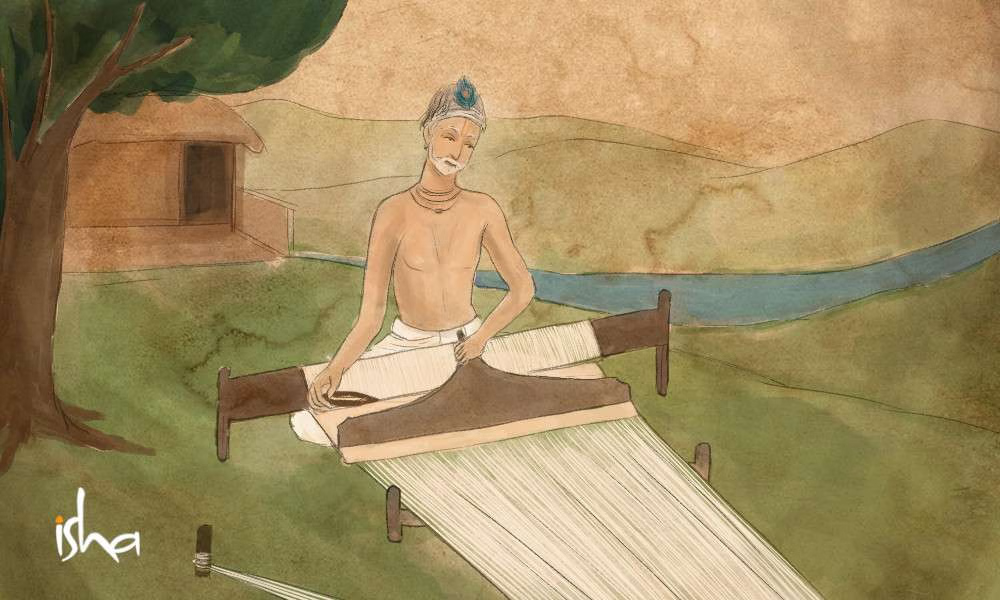
Embracing the Unity of All Forms
The quote "The formless is in the midst of all forms," attributed to the revered poet-saint Kabir, invites us to contemplate the profound relationship between the tangible and the intangible. At its core, this statement suggests that the essence of existence transcends the myriad forms we perceive in our daily lives. Understanding this unity is not merely an intellectual exercise; it is a transformative realization that can deepen our connection to ourselves, others, and the universe. In a world often dominated by division and separation, Kabir's insight serves as a reminder of the underlying oneness that binds all creation.
Delving deeper into this quote reveals a rich tapestry of meaning that resonates with the human experience. The interplay between the formless and the formed speaks to the dual nature of reality, where the visible and the invisible coexist in a delicate balance. This understanding encourages us to look beyond superficial differences and recognize the shared essence that lies beneath. In doing so, we can cultivate a sense of compassion and empathy, fostering a more harmonious existence in our relationships and communities.
The image / the metaphor
At first glance, the imagery in Kabir's quote evokes a sense of paradox. The term "formless" conjures visions of an infinite, boundless reality, while "all forms" suggests the myriad shapes and structures that populate our world. The verbs chosen here—"is" and "in"—imply a dynamic relationship, where the formless essence permeates and sustains the forms we encounter. This interplay invites us to explore the nature of existence itself, urging us to consider how the formless essence manifests through the diverse expressions of life.
As we delve deeper into the metaphor, we begin to appreciate the formless as a source of creativity and potential. It represents the unconditioned consciousness that underlies all phenomena, a wellspring from which all forms arise. This perspective encourages us to see beyond the surface of our experiences, recognizing that every form—be it a person, an object, or an idea—carries within it the imprint of the formless. By embracing this understanding, we can cultivate a sense of reverence for the interconnectedness of all things, fostering a greater appreciation for the beauty and complexity of life.
In the speaker's tradition
Kabir's teachings are deeply rooted in the bhakti tradition, which emphasizes devotion and love for the divine as a means of realizing unity with the ultimate reality. Concepts such as dharma, kenosis, and fana resonate with the essence of his message, highlighting the importance of surrendering the ego to experience the formless presence that permeates all existence. In bhakti, the act of devotion becomes a pathway to recognizing the divine in every aspect of life, reinforcing the idea that the formless is indeed present within all forms.
In the context of Kabir's poetry, we can draw parallels to the Buddhist concept of sunyata, or emptiness, which suggests that all forms are transient and interdependent. Just as Kabir speaks of the formless being present in all forms, sunyata invites us to recognize the impermanence of our experiences and the interconnectedness of all beings. This understanding can lead to a profound sense of liberation, as we learn to navigate the world with a sense of openness and acceptance, free from the constraints of rigid identities and attachments.
Living the teaching
Consider a modern scenario where this teaching can take root: a workplace filled with diverse personalities and perspectives. In such an environment, it is easy to become entrenched in our individual roles and responsibilities, often leading to misunderstandings and conflicts. However, by embracing Kabir's insight, we can approach our colleagues with a sense of curiosity and compassion, recognizing that beneath their unique forms lies a shared humanity. This shift in perspective can foster collaboration and creativity, transforming the workplace into a space of unity and mutual support.
Another application of this teaching can be found in our personal relationships. Imagine a moment of tension with a loved one, where differences seem insurmountable. In such instances, recalling Kabir's wisdom can help us step back and see beyond the immediate conflict. By acknowledging the formless essence that connects us, we can cultivate empathy and understanding, allowing love to guide our interactions. This practice not only deepens our relationships but also reinforces the idea that the formless is indeed present in the midst of all forms, reminding us of our shared journey through life.
A reflection
As we contemplate Kabir's profound statement, we are invited to reflect on our own experiences of unity and separation. In what ways do we allow the forms of our lives—our identities, beliefs, and attachments—to obscure our recognition of the formless essence that connects us all? This contemplation can serve as a powerful reminder to seek the underlying unity in our interactions and experiences, encouraging us to embrace the formless in the midst of our daily lives.



Join the BrightStar Community
Stay connected with daily inspiration, event announcements, and community wisdom