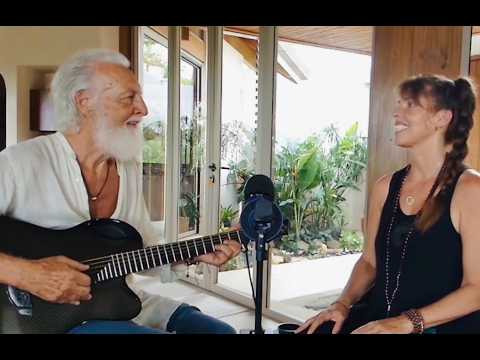
This concert performance features Deva Premal and Miten singing the Gayatri Mantra—one of Hinduism's most sacred invocations—alongside musician Manose and a collective audience. The Gayatri Mantra, chanted for thousands of years, invokes divine light and seeks to illuminate the intellect. This live performance demonstrates how mantra chanting functions as both personal spiritual practice and communal ritual, with the sonic and rhythmic dimensions of the practice creating resonance among participants.
What Is the Gayatri Mantra?
The Gayatri Mantra is one of the oldest and most revered mantras in Hindu tradition. The full text reads:
Om Bhur Bhuvah Svaha / Tat Savitur Varenyam / Bhargo Devasya Dhimahi / Dhiyo Yonah Prachodayat
This Sanskrit invocation is traditionally addressed to Savitur, the solar deity, and specifically invokes the divine light of the sun as a symbol of universal consciousness. The mantra's structure includes an invocation (Om Bhur Bhuvah Svaha), a description of the divine (Tat Savitur Varenyam), a meditation on that divinity (Bhargo Devasya Dhimahi), and a request for illumination of the intellect (Dhiyo Yonah Prachodayat).
The Gayatri Mantra has been chanted for over three thousand years in Hindu practice. It appears in the Rigveda, one of the oldest Sanskrit texts, and is central to the daily practice (sandhyavandana) of many Hindus. The mantra's power is said to lie not only in its meaning but in the vibrational quality of the Sanskrit syllables themselves when chanted aloud.
How Does Collective Mantra Chanting Work?
When multiple people chant a mantra together, the practice shifts from individual meditation to collective ritual. Each voice contributes to a unified sonic field, and the resonance created by many voices chanting in unison is understood in both ancient texts and modern acoustic science as having measurable effects on the body and environment.
In this concert setting, Deva Premal and Miten, along with Manose and the assembled audience, create a shared sonic space. The performers guide the melody and rhythm, while participants join in the repetition and invocation. This collective aspect of mantra chanting has several dimensions:
- Harmonic alignment: The shared frequency and rhythm create coherence among participants, potentially synchronizing breath and heart rate.
- Amplified intention: Individual intention for clarity, illumination, or spiritual connection is multiplied by group participation.
- Ritual containment: A live performance with skilled teachers provides a structured container in which participants can relax into the practice without needing to direct their own chanting.
- Call-and-response tradition: The use of trained singers (often called kirtanawallahs) to guide group mantra practice is an ancient method for transmitting these practices across communities.
The Role of Deva Premal & Miten in Mantra Transmission
Deva Premal and Miten have become widely recognized contemporary teachers and performers of Sanskrit mantra and kirtan (devotional chanting). Their approach combines traditional Sanskrit knowledge with accessible musical arrangements that invite modern Western audiences into these ancient practices.
By performing the Gayatri Mantra in concert settings, they serve several functions: they model proper pronunciation of Sanskrit syllables, they demonstrate how traditional melodies can be adapted for live performance, and they create opportunities for large numbers of people to participate in collective chanting who might not otherwise have access to traditional Hindu temple settings or Sanskrit teachers.
The inclusion of Manose as a special guest musician indicates the collaborative nature of kirtan and mantra practice. Different musicians bring different instrumental traditions—in this case, adding another layer of musical sophistication to the performance while honoring the core mantra itself.
Why the Focus on Solar Divinity and Intellect?
The Gayatri Mantra's reference to Savitur (the sun) and the invocation for illumination of the intellect (Dhiyo Yonah Prachodayat) point to a specific spiritual aim: the clarification and refinement of the mind. Unlike mantras focused purely on devotion, gratitude, or protection, the Gayatri specifically asks for "illumination" of the discriminative faculty—buddhi in Sanskrit, often translated as "wisdom" or "intellect."
This makes the Gayatri particularly relevant for practitioners seeking clarity in decision-making, deeper understanding of spiritual teachings, or a sharper perception of reality. The solar imagery—light penetrating darkness—reinforces this intellectual and spiritual illumination.
In contemporary practice, this aspect of the mantra appeals to people seeking meditation or spiritual tools that engage the mind constructively rather than attempting to bypass it. The invocation addresses something fundamental: the desire for clarity.
The Sound Current in Live Performance
A concert performance of mantra differs significantly from a recorded version or solo chanting. The live setting allows participants to experience what is called "ragas" in Indian classical music—the emotional and energetic qualities that arise from specific sound sequences, timing, and the presence of skilled practitioners.
Deva Premal is known for her clear enunciation and ability to hold sustained tones, qualities that allow the Sanskrit phonemes to resonate fully. When amplified in a concert hall with an engaged audience, this creates a feedback loop in which the singers' commitment and clarity inspire the participants' own commitment, deepening the collective experience.
Modern Access to Ancient Practices
The release of this performance as an excerpt from a CD/DVD titled "In Concert" reflects how traditional mantra practices now circulate in recorded media. This democratizes access—someone who cannot attend a live kirtan session in a temple or ashram can nonetheless experience the Gayatri Mantra sung by recognized teachers through digital platforms.
However, the fact that this is presented as an excerpt from a live performance (rather than a studio recording) underscores that something about the in-person, real-time nature of mantra chanting is considered worth preserving. The audience presence, the spontaneity of a live performance, and the collective energy are all part of the practice.
Where to Go From Here
If you are interested in deepening your own relationship with the Gayatri Mantra, several approaches are available. Learning the correct Sanskrit pronunciation through audio resources or live instruction is foundational—the mantra's power is traditionally understood to depend on correct vocalization. Practicing the mantra daily, even for five or ten minutes, can yield observable shifts in mental clarity over weeks and months.
Seeking out live kirtan performances or group chanting sessions in your area offers the collective dimension that this concert performance illustrates. Many yoga centers, temples, and spiritual communities now offer regular group mantra practice. Online platforms including Deva Premal & Miten's Gayatri Sangha App provide guided access to mantra instruction and group practice across distance.
Understanding the literal meaning of the Gayatri Mantra—its invocation of divine light and request for intellectual clarity—deepens appreciation for what you are chanting beyond the sonic and musical dimensions. Finally, exploring the broader context of mantra in Hindu philosophy, the role of sound (shabda) in spiritual practice, and the relationship between intention and vibration can help integrate this practice into a coherent spiritual framework rather than experiencing it as an isolated technique.